


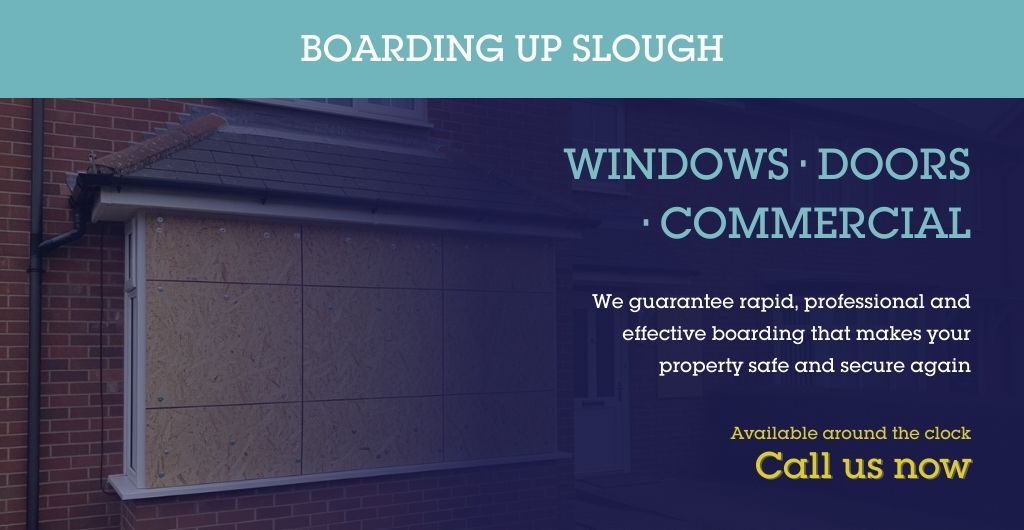
FAQs — Boarding Up Slough (SL Postcodes)
When your window or door has been damaged, you usually want two things: the property secured quickly and a clear idea of what happens next. These FAQs cover how boarding up in Slough works, what we typically need from you, and how we handle common situations across SL0–SL9 (and the wider SL area).
If you need urgent help, use our emergency page: emergency boarding up.
Quick answers (for when you’re stressed and in a hurry)
- If there’s an immediate security risk: call us and we’ll talk you through next steps. Call 01753 379 919
- If police have attended: keep your crime reference number and take photos if it’s safe.
- If it’s a commercial site: tell us whether shutters are down, if there’s rear access, and any alarms/on-site security.
- If the opening is large (shopfront/Patio/rooflight): we may recommend thicker sheeting, additional bracing, or alternative security.
For an overview of what boarding up actually involves, see: what boarding up is.
Emergency & call-out FAQs
Do you offer 24 hour / out of hours boarding up in Slough?
Yes. We provide 24 hour boarding up in Slough for urgent situations—break-ins, vandalism, storm damage, or accidental impact—across the SL postcodes. We don’t promise fixed arrival times because access, traffic and the nature of the damage vary, but we prioritise genuine emergencies.
If you need help now, go straight to: emergency boarding up.
Who should I call first — the police, my insurer, or a boarding-up company?
- If there’s danger, a crime in progress, or someone could be inside: call 999.
- If it’s safe but criminal damage/burglary has occurred: report it (101) and get a reference number.
- Then call us to secure the opening, especially if the property will be unattended overnight.
- Contact your insurer early—we can provide the documentation they typically ask for, but we’re not loss adjusters.
If this is burglary-related, you may also want: burglary repairs and boarding.
What information do you need when I call?
A quick, accurate description helps us bring the right fixings and board size:
- Address/postcode (e.g., SL1/SL2 around central Slough, SL3 Langley/Colnbrook, SL4 Windsor side)
- What’s damaged (window/door/shopfront/rooflight) and roughly how big
- Whether glass is still loose, and if there are children/pets on site
- Access details (rear alley, side gate, flats with communal entry, keys with neighbour/agent)
- Whether police/fire service have attended (and if they’ve asked for anything specific)
For planned, non-urgent work, use our contact page and we’ll arrange a suitable time.
Can you board up tonight if my window is smashed?
Often, yes—this is a common reason people search “who can board up my window tonight in Slough”. If it’s safe to do so, we’ll secure the opening and help reduce the chance of further damage or opportunistic entry.
For dedicated urgent support, use: 24-hour emergency boarding-up in Slough.
Do you handle shopfronts and commercial glazing out of hours?
Yes. We regularly secure shopfronts and commercial entrances, including larger glazed panels and doors. If you’re in a parade near busy roads or footfall areas, boarding up quickly can help prevent further breakage and liability issues.
See: shopfront boarding in Slough and commercial boarding up.
Services & methods FAQs
What’s the difference between plywood boarding and OSB?
Both are sheet materials used to cover openings, but they’re not identical:
- Plywood (often exterior-grade, e.g., 18mm for larger openings) is strong, stable, and less prone to edge crumbling—useful for bigger window bays, doors, and commercial openings.
- OSB (commonly 12mm for smaller openings) can be suitable for certain short-term boarding jobs where the opening is smaller and the risk profile is lower.
We’ll recommend what’s appropriate based on the opening size, the frame condition, and how long the property is likely to be left.
Learn more about common applications on: window boarding in Slough.
How do you fix boards so they can’t be removed easily from outside?
Where appropriate, we use anti-tamper fixings and methods that reduce the chance of boards being levered off. The safest approach depends on the frame material (uPVC, timber, aluminium) and how damaged it is.
If the frame is too compromised for non-destructive methods, we’ll explain the options before proceeding—particularly important for doors and commercial entrances.
Related: door boarding in Slough.
Can you board up doors as well as windows?
Yes. Door security is often more urgent than window boarding after a forced entry. Depending on the damage, we may:
- Board over or brace the door area
- Secure the opening to prevent entry and weather exposure
- Recommend a stronger temporary solution for medium-term security
If the property will be empty, you may also want: vacant property boarding.
Do you install temporary steel doors?
Yes—temporary steel doors are a strong option for forced entries, repeated incidents, or voids where you need a proper, lockable temporary entrance rather than repeated re-boarding.
If you’re not sure whether you need a temporary steel door or standard boarding, call and we’ll talk through the risk and access requirements. For general door security, see: door boarding in Slough.
Can you board up a rooflight or damaged roof opening?
Yes. Rooflights, skylights, and other overhead openings need a slightly different approach because water ingress becomes the immediate risk and safe access is critical. We’ll advise on the best way to secure and weatherproof the opening as a temporary measure.
See: roof boarding in Slough.
Do you provide security screens or longer-term solutions?
For longer-term or higher-risk voids, steel security screens can be an option. The right solution depends on whether the building needs ventilation, whether there’s frequent footfall nearby, and how long the property will be empty.
A good starting point is: vacant property boarding.
Pricing, quotes & paperwork FAQs
How much does boarding up cost in Slough?
Costs vary, and we avoid publishing fixed prices because two “broken windows” can be completely different jobs. The main cost factors include:
- Size and number of openings
- Material choice (e.g., 12mm OSB vs thicker exterior-grade plywood)
- Complexity of access (upper floors, tight rear access, shopfront height)
- Whether temporary doors/screens are required
- Whether the frame is sound enough for non-destructive fixing
For a clear explanation of cost drivers, see: pricing.
Do you provide photos and documentation for insurance?
Yes. We can provide practical documentation insurers typically ask for, such as:
- Time-stamped photos of the damage and the secured opening
- A written description of works carried out
- An itemised invoice/statement for your claim
We’re not loss adjusters and we can’t approve claims, but we’ll help you compile what’s usually needed.
More guidance: insurance claims help.
Is boarding up covered by insurance?
Sometimes, depending on your policy, excess, and the circumstances (e.g., burglary, storm damage). It’s worth reporting the incident and checking your cover. If the property is insecure, most insurers expect “reasonable steps” to prevent further loss—boarding up is often part of that.
See: insurance claims help.
Do you work with landlords, managing agents and facilities teams?
Yes. We regularly help landlords, letting agents, and facilities managers secure properties between tenancies or after incidents. If you need paperwork for your internal process (purchase order references, site sign-off notes), tell us when you call.
Related: residential boarding up and commercial boarding up.
Situations we’re asked about (real-world problems)
What should I do after a burglary or attempted break-in?
If it’s safe:
- Don’t touch points of entry—police may need to check for evidence.
- Take photos of damage (inside and outside) if you can do so safely.
- Get your crime reference number.
- Call us to secure the opening and reduce the risk of repeat entry.
More detail: burglary repairs and boarding.
What if it’s vandalism rather than a break-in?
Vandalism still leaves you exposed—especially if glass has been smashed or the frame has been weakened. We’ll secure the opening to deter further damage and help keep the property weather-tight.
More detail: vandalism repair and boarding.
Can you help after storm damage?
Yes. High winds can break windows, dislodge panels, or damage rooflights—particularly where debris has hit the property. Once it’s safe, we can board up or secure openings as a temporary measure.
More detail: storm damage boarding.
Do you board up after a fire?
Yes—once the site is safe and you have permission to enter, we can secure doors and windows to prevent further loss or unauthorised access. We don’t carry out smoke/odour remediation or building drying, but we can help protect the property while next steps are arranged.
More detail: fire damage securing.
What about flood damage and swollen doors/windows?
Flooding can warp timber, swell doors, and compromise frames so they won’t close properly. We can secure vulnerable openings, but we may also recommend ventilation considerations depending on the property condition and insurer guidance.
More detail: flood damage securing.
Location & access FAQs (Slough and the SL area)
Which areas do you cover?
We cover Slough and the wider SL postcode area, including nearby towns and villages. That includes places like Langley, Cippenham, Britwell, Colnbrook, and out towards Windsor, Maidenhead, Burnham, Gerrards Cross and Beaconsfield-side locations within SL districts.
See the full list here: areas we cover and our main location page: boarding up in Slough.
Are there access challenges you commonly see around Slough?
Yes—Slough has a mix of housing and commercial property, so access varies. Typical challenges include:
- Flats with communal doors and restricted parking near town-centre streets
- Rear access issues behind terraced rows or tight service alleys
- Busy commercial areas where safe working space needs planning
- Industrial estates with gates, security, and sign-in requirements
If you can, tell us in advance about parking restrictions, height/upper-floor access, and whether keys are with an agent or concierge.
Can you secure properties near stations and high-footfall areas?
Yes. High-footfall areas can increase the risk of further damage once a window is broken. If the property is near a station, a parade of shops, or a busy road, prompt temporary security is often sensible.
If you’re unsure what’s best (boarding vs temporary door/screen), call and we’ll talk it through.
What to expect from us
What happens when you arrive?
We’ll assess the opening, the condition of the frame, and the safest fixing method. Our aim is to:
- Secure the property against entry
- Reduce weather exposure (as far as practical for a temporary measure)
- Leave the site as safe and tidy as possible given the circumstances
- Provide photos and paperwork if you need them for an insurer or landlord/agent file
If additional risks are obvious (for example, a frame that’s too damaged to fix into safely), we’ll explain what we can and can’t do before starting.
Are your technicians insured and DBS-checked?
We operate with appropriate insurance for this type of work, and we understand that security-related call-outs often need professionalism and discretion. If you have site rules (sign-in, RAMS, escort requirements), let us know when booking—especially on commercial premises.
Still have a question?
If you can’t find the answer here, get in touch and we’ll give straightforward guidance based on your situation.
Ready to get started? Call 01753 379 919 or email us for a free, no-obligation quote.
